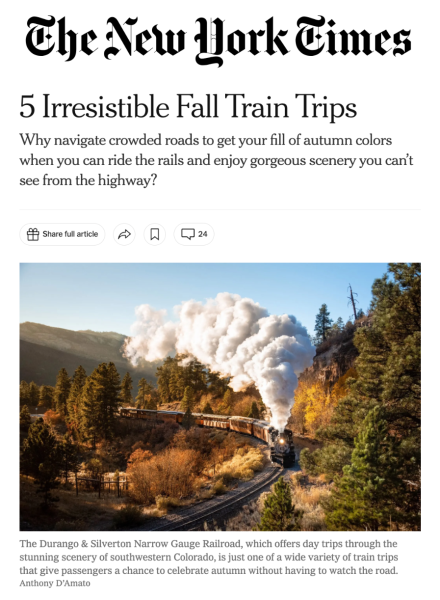
See why The New York Times just named us one of
“5 Irresistible Fall Train Trips”
There’s still time to ride before the season ends!
Last Ride of the Season: October 26th
Durango is accessible by US Hwy 550 from the north and south, and US Hwy 160 from the east and west. D&SNGRR on map. If you’re driving in Colorado, you can find current road conditions by visiting the CO Department of Transportation’s Web site at www.COTrip.org For recorded phone information call: 303-639-1111 or instate toll free 877-315-7623.
Yes, Durango is easily and conveniently accessible by air. The Durango-La Plata County Airport (Airport Code: DRO) is serviced by American Airlines, Frontier Airlines, United Airlines and US Air. Click here La Plata County Airport for current information. The La Plata County Airport is approximately 12 miles from downtown Durango. Other nearby airports include Animas Air Park, Cortez Municipal Airport in CO and Four Corners Regional Airport in NM.
The closest international airport to Durango is Albuquerque International Sunport located in Albuquerque, New Mexico, approximately a three and a half hour drive south of Durango. Durango is located in southwest Colorado near the Four Corners, where the borders of Colorado, Utah, Arizona, and New Mexico meet.
Approximately 340 miles depending on which route you take. You can count on beautiful scenery no matter which route you choose so make plans to stop often to visit the towns you’ll pass through! Plan your trip here using Google Maps -we’ve already marked your destination!
Probably the most important thing to know about riding the train is “Safety First”. We highly recommend wearing sturdy, closed-toe, closed-heel shoes. Besides helping to ensure safe movement on board and when boarding and deboarding the train, navigation in Silverton will be more comfortable. With the high elevation and brilliant sunshine, a hat, sunglasses and sunscreen are necessities. The train climbs nearly 3,000 feet to Silverton and the high mountain air will be about 10 degrees cooler than in Durango. Mountain weather in Colorado is often unpredictable. Wearing layers of clothing that you can remove or add as the temperature changes will add to the enjoyment of your journey.
The D&SNGRR offers a train car with a wheelchair-accessible restroom and lift service! This car is scheduled to run daily on our summer train to Silverton and on the winter train to Cascade Canyon. The wheelchair can be locked in position and you can ride right in the same car with the passenger in the wheelchair. Be sure to ask for the ADA car when booking.
THERE IS ONLY ONE WHEELCHAIR-ACCESSIBLE CAR IN OUR FLEET. WITHOUT ADVANCE BOOKING, WE CANNOT GUARANTEE THAT IT WILL BE AVAILABLE FOR YOUR PARTY. PLEASE, PLEASE, PLEASE CALL AHEAD TO BOOK THIS SERVICE!
Yes. Restrooms are located in the rear of each of the enclosed standard coaches and are accessible for all passengers. Premium coaches also have their own restrooms accessible only by premium-class ticket holders. There is one standard coach with ADA-accessible restroom.
No live animals are allowed on the D&SNG trains except for service animals with their owner or trainer. Durango has several pet boarding facilities. We strongly encourage our guests to find suitable daytime facilities for your pets and to not leave them in your parked car.
No. There is no smoking in any car, platform, bathroom or any other area on board the train. This includes cigarettes, cigars, pipes, e-cigs, vapor pens and all other devices.
Due to liquor regulations, no personal alcohol can be brought on board the train. Premium cars have alcoholic beverages for purchase and standard class passengers can go to the Concession car to purchase alcohol. The minimum legal drinking age in Colorado is 21.
Passengers are not permitted to carry firearms on the train. Backpackers and hunters may arrange for firearms to be transported as freight. Please contact Special Handling in the Reservation Office at 970-385-8832 to make arrangements.
The ticket on your smartphone is perfect! No need to have anything printed.
The D&SNG parking lot is located next to the rail yard at the corner of U.S. Hwy 550 and College Drive, just west of the McDonald’s restaurant. Parking address: 209 W College Drive. For more information click here.
There is a cancellation fee of $14 per adult ticket and $7 per child ticket if you choose to cancel your trip. No refund will be given if cancelled within 5 days of train trip.
For passengers wishing to ride the train one way and travel the other direction by bus over the San Juan Skyway, we have quite a few options. Passengers are also welcome to ride the train one way and make their own arrangements for passage beyond their stopping point. The reserved seat fare is the same as a round trip fare.
Durango’s elevation is 6,512 feet above sea level and Silverton sits comfortably at 9,305 feet elevation. To help thwart altitude sickness (headache and nausea) guests are encouraged to get plenty of rest, drink lots of water and avoid alcohol and caffeine. Whenever possible, try to acclimate to the altitude by arriving a day early. If you have any health concerns, check with your physician for advice.
To find your car, refer to the numbers on the small, black tags at the end of each car (look for two-digit numbers only). The large number painted on the car (usually three digits) is the number assigned to the car by the manufacturer. All seats in all car classes on the train are assigned. Seat numbers are located above the Coach seats and in front of the Gondola seats.
After tickets are collected, passengers may walk through the train to visit the Concession Car and restrooms. Except for specific special event trains, all seats are reserved throughout the train and there is no ‘open’ seating.
Yes, Caboose Coffee Shop is located in the south end of the Durango train depot. It features a variety of hot and cold beverages including lattes, cappuccinos, chai, hot coffee, iced coffee, soda, iced tea, smoothies, hot tea, hot chocolate and hot apple cider. Our coffee beverages are made with locally roasted, organic coffee and espresso beans. We also feature a variety of candy and snacks and proudly carry locally-produced items from Honeyville, The Durango Diner, Ricky’s Lucky Nuts, and Desert Sun Coffee Roasters.
Yes. Refreshments are for sale in our concession car located toward the center of the train. The menu includes breakfast and lunch snack items, hot coffee, hot chocolate and other drinks. A wide selection of hot and cold beverages, including a full bar with five locally-brewed beers, is available in the concession car. Be sure to purchase your souvenir mug on board and get FREE non-alcoholic beverage refills all day long!
The D&SNGRR Museum is at the south end of the roundhouse in Durango. It is open daily in the summer May-October and on dates the Cascade Canyon Train is running Nov-April.
Coaches are fully enclosed with windows and doors that open and close. Seats face forward. Our gondolas have full roofs, open sides, and seats that face outward. We encourage passengers on gondolas to bring jackets (jackets, ponchos and fleeces are also available for purchase in the gift shop) and dress appropriately for outdoor weather conditions.
Five people: Conductor, Head Brakeman, Rear Brakeman, Engineer and Fireman. The crew also includes attendants in the Concession Car and the Private cars. The conductor is in charge! The brakeman assists the conductor.
Narrow gauge rails are three feet (36 inches) apart, while standard gauge rails are four feet, 8 1/2 inches (56 1/2 inches), which is a standard based on Roman chariot wheels. The D&RG chose to build narrow gauge because the construction was cheaper, the equipment cost less and the narrow gauge was better suited to the sharper curves of the mountain terrain.
All of the steam locomotives have been converted to oil-burning as of 2024.
The train travels at a top speed of 18 mph (regular speed with all the coaches).
We have 3 K-28s (473, 476, 478) and 4 K-36s (480, 481, 482, 486).
Our K-28s weigh 254,500 pounds when loaded with coal and water. The K-28s are numbered in the 470 series. Our K-36s weigh 286,600 pounds when loaded with coal and water. The K-36s are numbered in the 480 series.
Yes, the D&S owns the former White Pass & Yukon Railroad’s #101, #103 and #107 locomotives. D&S purchased “Hot Shot 1” which was put into service in July of 2002 primarily as an emergency and fire prevention vehicle. The D&S purchased four additional diesel locomotives in September 2002, which have been restored to operating condition and are now used for switching in the yard, maintenance along our right-of-way, fire prevention and emergency use. The diesel locomotives are used for daily train switching once the steam locomotives return for the night. All regular passenger trains are pulled by either steam or diesel locomotives.
No. 42 (on display in the D&SNGRR Museum) was built in 1887. The locomotives used for daily service are from 1923 and 1925.
Since 1998 the D&SNGRR has been owned and operated by American Heritage Railways; Allen and Carol Harper, principal owners. Prior to that, Charles E. Bradshaw, Jr. purchased the line from the D&RGW in 1981, renamed it the Durango & Silverton Narrow Gauge Railroad and expanded the passenger service.
Colorado Territory (1949), Ticket to Tomahawk (1950), Denver & Rio Grande (1952), Viva Zapata (1952), Three Young Texans (1954), Run for Cover (1955), Maverick Queen (1956), Around the World in 80 Days (1956), Night Passage (1957), How the West Was Won (1963), Butch Cassidy and the Sundance Kid (1969), Support Your Local Gunfighter (1970), Durango & Silverton Narrow Gauge Railroad (1984), The Tracker (1987), Rebirth of a Locomotive (1992), Tracks Through Time (1999), Durango Kids (1999), Golden Dreams (2000), The Claim (2000), The Prestige (2006), Godless Miniseries (2017), IMAX Film Into America’s Wild (2020), Hostile Territory (2022).
Last Ride of the Season: October 26th
Due to significant recent weather events, The Durango & Silverton Narrow Gauge Railroad had a slide at milepost 486.0 just north of Needleton which resulted in the tracks being covered with rock and debris, making train passage to Silverton impossible. Due to this, we have had an interruption of service to Silverton and both Silverton trains have been rerouted to Cascade Canyon for tomorrow, July 3rd. resume service to Silverton on July 4th and will be communicating with guests if there is any change. Our maintenance of way crews are actively working to clear the slide and to restore the tracks.
We look forward to restoring full Silverton service on July3 3rd.

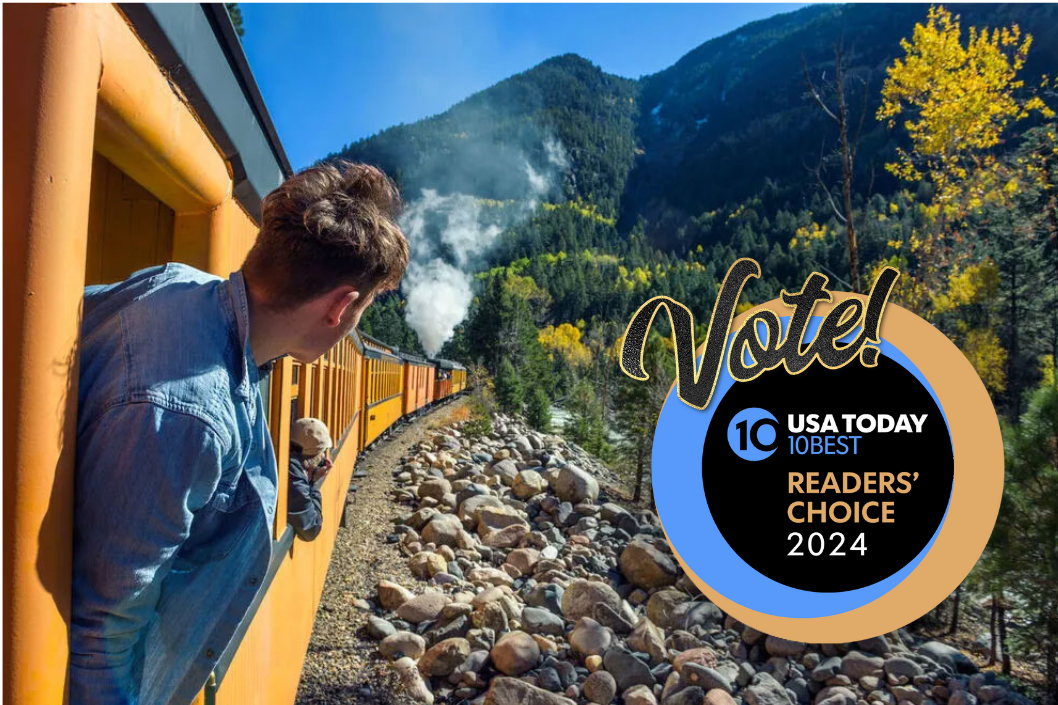
We think so, but we’re also a little biased. We’re incredibly thankful to be nominated as one of the “Top 10 Scenic Train Ride in North America” by USA Today! From today until May 13th, you can vote for your all-time favorite scenic train. Do you think we deserve this honorable merit? Then click the link below and vote for the Durango Train! Throughout the duration of the voting period, fans may cast a single vote each day leading up to its conclusion.
We are now operating daily and our train schedule has in fact expanded as we’ve moved deeper into the summer season.
We experienced a brief pause in railroad operations recently while we worked through communications with the Forest Service on our operating status while observing agreed upon fire precautions. Concurrently, we were able to rebook passengers to adjacent days when train excursions were operating.
All trains scheduled for Thursday, June 16 and beyond are operating as scheduled at this time.
Please know that if we experience any interruptions in service due to future fire precaution levels, we will reach out to all of our guests in a most timely manner to offer information and alternatives.
Thank you”
You can see how this popup was set up in our step-by-step guide: https://wppopupmaker.com/guides/auto-opening-announcement-popups/